
The Freedom Seeker and the Wagon
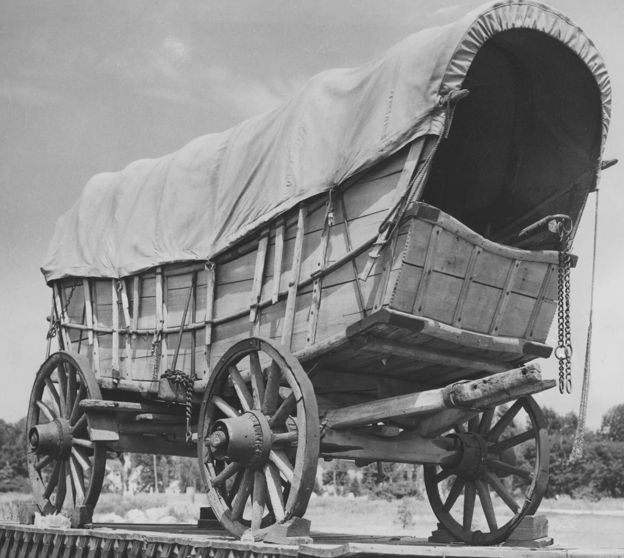
Wagon technology of Antebellum America ranged from the “immense” Prairie Schooner to the petty mule cart, with many regional variants recorded in period biographies, such as the “express wagon” and the “Pennsylvania wagon” (O’Neal 7; Troy 25; Steward 120). Although its technical function varies little from global examples, the wagon’s cultural significance stands apart. As one of the principal tools of the southern agro economy, its roles—both technical and cultural—developed concurrently with slave labor practices. Still, the wagon is a versatile tool, one which defies overly deterministic readings of its history. The very same wagon might serve to forcibly divide mothers from children, serve as a symbol of solidarity among Black harvesters, propel slave patrols cross-country, and bear freedom-seekers northward. A Black American also might apply vastly different interpretations of the wagon, given only subtle adjustments to circumstance. Driving mules from the wagon seat, a teamster might enjoy elevated dignity among his peers, while one bound in chains behind that vehicle might stumble in its dust. A hidden compartment might convey a fearful and hopeful family out of the south, even as the same wagon’s clatter suggested a pursuing patrol to a nearby listener.
The Wagon in Antebellum Society
In the economy of the south, the wagon served an indispensable role in the harvesting and transportation of crops. The similarly indispensable role served by the enslaved meant that conflations of human and technology were commonplace. When Harry Thomas was captured in southern Indiana, he found himself chained to a wagon with plough chains, which posed him as a beast of burden and connected his body to the agricultural apparatus he was compelled to serve (Drew 304). Black laborers strove to carve out forms of personal dignity within these instrumentalizing arrangements, and this often took the form of a troubled intimacy between the human and the farming apparatus. Harry Clay Bruce described his work as a wagon driver as a “master” who “almost loved [his] oxen” (89). In this instance, the wagon facilitates nested tiers of mastery, from enslaver to enslaved to animal, and ultimately it leads the Bruce to replicate unwholesome power relations.
Despite the grievous ways in which the enslaved were instrumentalized by the agricultural process, communal solidarity also could coalesce around the wagon. Nina Hill Robinson describes one annual cornshucking:
guests crowded from over the hills and up the valleys, by twos and threes on horseback and muleback; by the dozen in heavy, lumbering wagons; by the half dozen in swift-gliding canoes. The work began. The heaps of corn, piled high in the cribs, dwindled surely under the strong hands of the shuckers. Cæsar, ever mindful of an opportune moment to display his superior excellence, stepped grandly in his best clothes from crib to crib, ordering his troop of busy boys in gathering the huskings, or stowing the corn into barrels. Old men passed the compliments of the day or related their experiences, replete with wisdom. Young men “swapped” their jokes, or bantered for shucking races in braggadocio-like tones. A low, monotonous chanting slowly gathered strength as the dark, smart faces swayed back and forth under the gleaming lamplight. (32)
In Robinson’s account, the holiday celebration around this feat of labor, “second only to the Christmas festivities,” neither mitigates nor excuses the compulsory labor; rather, joy rises from within the circumstance of enslavement, forming a momentary cordon of dignity in its midst (30). As for the wagon, it holds the bounty of the harvest and allows the laborers to admire it with pride, even as they know well that it will shortly enrich their enslavers.
In the social hierarchies of the south, the wagon took on various symbolic values. Masters would ride on horseback ahead of the wagon during the day and enjoy public houses at night, while the enslaved would remain with the wagon and mules (Ball 282). In other circumstances, the technology might be deemed too dignified for a Black man, including within the Union army, where James L. Smith was denied the role of wagon-driver. (79) Yet, the technology could serve to elevate social status as welll. Not unlike the American automobile of the mid-twentieth century, the wagon marked a prosperous homestead for emancipated people. (Steward 219; Tilmon 77). Whereas for some, the wagon codified social status, in other cases, it was the pragmatic means of social ascent. Booker T. Washington offers some of the earliest notes on a what should be understood as a commuting student when he describes the wagon bearing farmers across many miles to the Tuskegee Institute and thereby granting upward social mobility (Builder 76).
Slavery’s Vehicle
No technology distinguished the amateur slave patroller from the professional bounty hunter quite like the wagon. In practical terms, it would have been impossible to transport a resistant prisoner, whereas one tied to the frame could be whisked speedily to a local impound. Hence, while tales of amateur foot pursuit abound, all formalized patrols kept a wagon at the ready:
whether it was night or day, it was only necessary to whisper in a certain circle that a negro was to be caught, and horses and wagons, men and officers, spies and betrayers, were ready, at the shortest notice, armed and equipped, and eager for the chase. (Parker 281)
As patrols normalized techniques of pursuit and their attendant technologies, the wagon began to emerge as a prototypical version of the patrol car. In the account of Archer Alexander’s life, for example, the official numbering of a “city wagon” provided sufficient authority to reclaim emancipated slaves from under the noses of occupying Union forces (Eliot 68). In time, even the sound of a wheel could provoke the freedom-seeker to suspicion, and thus the canny slave patroller learned to leave his wagon behind as he laid his ambush (Griest 113).
Wagons also proved important to the local, improvisational enforcement of slavery. In multiple accounts, the vehicle bears the alcohol needed to sustain the mob fervor of the hunters. For instance, first hand accounts describe how a wagon bore the kegs of beer that sustained a lynch mob during the Detroit Race Riot of 1863, and Kate Pickard describes amateur hunters imbibing whisky to drum up courage to seize a family near Vincennes, Indiana (Thrilling Narrative 3; 297). In these cases, the wagon served as a mobile locus of lawlessness; its sturdy presence provided a superficial connection to institutional authority where in truth vigilantism prevailed. Somewhat less directly, this vehicle also served to enforce slavery’s institution by furnishing the wagon whip, which is ubiquitous in first-hand accounts of discipline and torture. (Drew 44; Weld 99; Browne 281)
Families divided by ruthless slave auctions often saw their last sights of sons and daughters, husbands and wives from the vantage of a wagon bed, and the wagon’s imaginary gripped the minds of the enslaved as they anticipated or recalled these horrid partings. For example, in her biography, Sally Williams describes the nightmare of a wagon propelling her child ever out of reach (90). “Dreadful… outcries” recur in period accounts, striking a jarring contrast with the carnivalesque atmosphere that arose as enslavers circled their wagons around the auction block (Drew 38). These scenes frequently appear to have devolved into exuberant pageants in which costumed attendees would use the occasion of human sale to indulge in “music, dancing, trading in horses, gambling, drinking, fighting, and every other species of amusement and excess” (Ball 297). During these festivals, wagons served as ad hoc grandstands, and wagon yards became synonymous with slave impounds (Aunt Sally 11). Still, the vehicle served crueler roles than a mere human container. Many writings describe the enslaved in terms apposite to commodities, which were variously crammed, stacked, and piled in the bed. At its most gruesome, this could mean that children were “thrown in naked one on top of another, just like pigs. When they stop, they sometimes find one or two smothered” (Recollections of Slavery). Failing to fit in the vehicle, many would be compelled to follow behind, with bare feet that became “bruised and swollen” (Aunt Sally 122).
Wagons North
Not only an instrument of the slave patrol but a welcome relief for weary travelers, the wagon was interpreted, more often than not, as a symbol of uncertainty. Should one hail a passing farmer or labor on in the rigors of the roadside undergrowth? Without any way of assessing the sympathies of drivers or crew, the self-emancipated often only begged a ride when they found themselves at the peak of exhaustion. In some instances, begging could be met with seemingly boundless kindness, such as when Charles Ball gained a “secure and easy position” as he fled toward Savannah, Georgia (416). William Wells Brown begged help in a “very pro-slavery neighborhood” only because he had become desperately ill. He waited in trepidation, fully expecting the man to return with a posse but was relieved when instead he came with a two-horse wagon and turned out to be a “Quaker of the George Fox stamp” (Narrative 100). Other travelers were more cautious. After nearly being apprehended by the teamsters of a wagon train, Moses Roper determined to never approach nearer than “a quarter of a mile” (30).
Pilots of the Underground Railroad made frequent use of the wagon as a means of efficiently spiriting the enslaved northward to safety. At times, this could be as simple as it was for Harriet Tubman, who, in one account, “quietly drove off with her parents and seemed to have met no trouble in reaching free soil” (Homespun Heroes 57). Other accounts describe more elaborate deceptions and stratagems. Reverend W.H. Robinson recalls wagons with “double linings, with corn or wheat visible, while the cavity was filled with women and children” (13). Edward Hicks escaped in a wagon bed while covered uncomfortably with food and clothes (Drew 266). James Williams used the excuse of buttoning his wagon against the rain so as to preserve his grain, as well as those hidden beneath it (15).
These covert passages to freedom might traverse hundreds of miles under the supervision of a single driver, but more typical was the systematic arrangement that William Robinson describes:
The system of deliverance by the underground railroad was to divide the country off into sections, and at every fifteen or twenty miles would be a station or depot. One man would haul the slaves at night to the end of his station and get back home before daylight, undiscovered, then they would be conveyed the next night in wagons from that station to the next, and so on until they reached Canada. (13)
Much as the well-prepared slave patrol kept a wagon at the ready, so too did key stations on the UGRR maintain a fleet of the vehicles. In the words of Booker T. Washington, “Clothing, food, shoes, carriages, wagons, horses, and mules were always at hand” (Frederick Douglass 164).
Naturally, the traffic of freedom-seekers by wagon was well known to patrollers, and many accounts describe routine searches (Drew 267). At typical checkpoints such as bridges and crossings, more elaborate ruses were necessary to avoid search. For example, the Quaker pilot Thomas Garrett gathered a band of raucous bricklayers to fill a convoy of wagons, thereby hiding the fugitives, who lay prone in the wagon beds, with the spectacle (Scenes in the Life 31). When encounters between concealed passengers and patrollers went bad, violence often prevailed. The Maryland Examiner describes one such attempted capture: a patrol identified a party of self-emancipated by the “spring wagons” they had stolen. When the patrol confronted the riders, they were forced to draw “revolvers and bowie knives, [keeping] their assailants at bay, until five of the party succeeded in escaping in one of the wagons” (James Williams 98). While it might be tempting to compare this event with the trope of the high-speed chase, the wagons play a more duplicitous role than the celebrated getaway car. Although this wagon saved all but one of the party, it also outed the Black passengers in the first place, who had no lawful rights or social permissions to own such a vehicle. This event epitomizes the role of the wagon writ large, which never played a singular role in the story of emancipation but instead conjoined the procedures of enslavement and labor, fugitivity and abolition.
Bibliography
Ball, Charles. (1859) Fifty Years in Chains, or, The Life of an American Slave. New York: H. Dayton; Indianapolis, Ind.: Asher & Co.
Bradford, Sarah H. (1869) Scenes in the Life of Harriet Tubman. Auburn, N.Y.: W.J. Moses, printer.
Brown, Hallie Q. Ed. (1926). Homespun Heroines and Other Women of Distinction. Xenia, Ohio: Aldine Pub. Co.
Browne, Martha Griffith. (1857) Autobiography of a Female Slave. New York: Redfield.
Bruce, Henry Clay. (1895) The New Man: Twenty-Nine Years a Slave, Twenty-Nine Years a Free Man. York, Pa.: P. Anstadt & Sons.
Drew, Benjamin, ed. A North-Side View of Slavery. The Refugee: or, The Narratives of Fugitive Slaves in Canada. Related by Themselves. With an Account of the History and Condition of the Colored Population of Upper Canada. Boston: J. P. Jewett, 1856.
Eliot, William Greenleaf. (1885) The Story of Archer Alexander: From Slavery to Freedom, March 30, 1863. Boston: Cupples, Upham and Company; Old Corner Bookstore.
Griest, Ellwood. (1873) John and Mary; or, The Fugitive Slaves, a Tale of South-Eastern Pennsylvania. Lancaster, PA: Inquirer.
No Author. (1863). A Thrilling Narrative from the Lips of the Sufferers of the Late Detroit Riot, March 6, 1863, With the Hair Breadth Escapes of Men, Women and Children, and Destruction of Colored Men’s Property, Not Less Than $15,000. Detroit: The Author.
No Author. (1838) Recollections of Slavery by a Runaway Slave. The Emancipator, August 23, September 13, September 20, October 11, October 18.
O’Neal, William (1896) Life and History of William O’Neal, or, The Man Who Sold His Wife, St. Louis, Mo.: A.R. Fleming.
Robsinon, Nina Hill. (1897) Aunt Dice: The Story of a Faithful Slave. South: Barber & Smith, agents.
Roper, Moses. (1838) A Narrative of the Adventures and Escape of Moses Roper, from American Slavery. Philadelphia: Merrihew & Gunn.
Scott, Emmett Jay, and Lyman Beecher Stowe. Booker T. Washington, Builder of a Civilization. Garden City, New York: Doubleday Page, 1916.
Smith, James Lindsay. (1881) Autobiography of James L. Smith, Including, Also, Reminiscences of Slave Life, Recollections of the War, Education of Freedmen, Causes of the Exodus, etc. Norwich, CT: The Bulletin.
Steward, Austin. (1857) Twenty-Two Years a Slave, and Forty Years a Freeman; Embracing a Correspondence of Several Years, While President of Wilberforce Colony, London, Canada West. Rochester, N.Y.: William Alling, 1857
Tilmon, Levin. (1853) A Brief Miscellaneous Narrative of the More Early Part of the Life of L. Tilmon: Pastor of a Colored Methodist Congregational Church in the City of New York. Jersey City: W.W. & L.A. Pratt, Printers.
Troy, William. (1861) Hair-breadth Escapes from Slavery to Freedom. Manchester: Bremner.
Weld, Theodore Dwight, (1839) American Slavery As It Is: Testimony of a Thousand Witnesses. New York: American Anti-Slavery Society.
Washington, Booker T. Frederick Douglass. London: Hodder and Stoughton, 1906.Williams, Isaac D., 1821-1898. Sunshine and Shadow of Slave Life: Reminiscences As Told by Isaac D. Williams to “Tege.” Ed. William Ferguson Goldie. East Saginaw, MI: Evening News, 1885.
Williams, Isaac. (1858) Aunt Sally: or, The Cross the Way of Freedom. A Narrative of the Slave-life and Purchase of the Mother of Rev. Isaac Williams of Detroit, Michigan. Cincinnati: American Reform Tract and Book Society.
Williams, James. (1873) Life and Adventures of James Williams, a Fugitive Slave, with a Full Description of the Underground Railroad. San Francisco: Women’s Union Print, 424 Montgomery Street.