
Patrols
The patrols that monitored northern Kentucky ranged from militias to mobs, and their variety has made them a subject of both intrigue and horror. Members of the patrols assume many names in period literature, including the regional idioms of “padrolers,” “patter-rolls,” and “paddywhackers” (Tenkotte and Claypool 835). According to the (1852) Revised Statutes of Kentucky, one captain should lead up to three men, but in the counties adjacent to the Ohio River, up to thirty members were permitted (65). This state law called for “sober and discrete” patrollers, but J.W.J. Coleman explains that volunteers could be better characterized as “pore whites” who rarely owned slaves yet celebrated the role as a sanctioned bloodsport (97). Marion B. Lucas agrees that the selection of patrollers was irregular, and further explains that volunteers’ behaviors often included “horseplay,” “scapegoating,” “Negro hunting,” and ultimately lynching (33). The Fugitive Slave Act of 1850 further empowered marshals to “summon and call to their aid the bystanders, or posse comitatus,” which in practice meant a mob could be incited without fear of legal retaliation. Once it was signed by president Millard Fillmore, this document ordered “all good citizens… to aid and assist in the prompt and efficient execution of this law.”
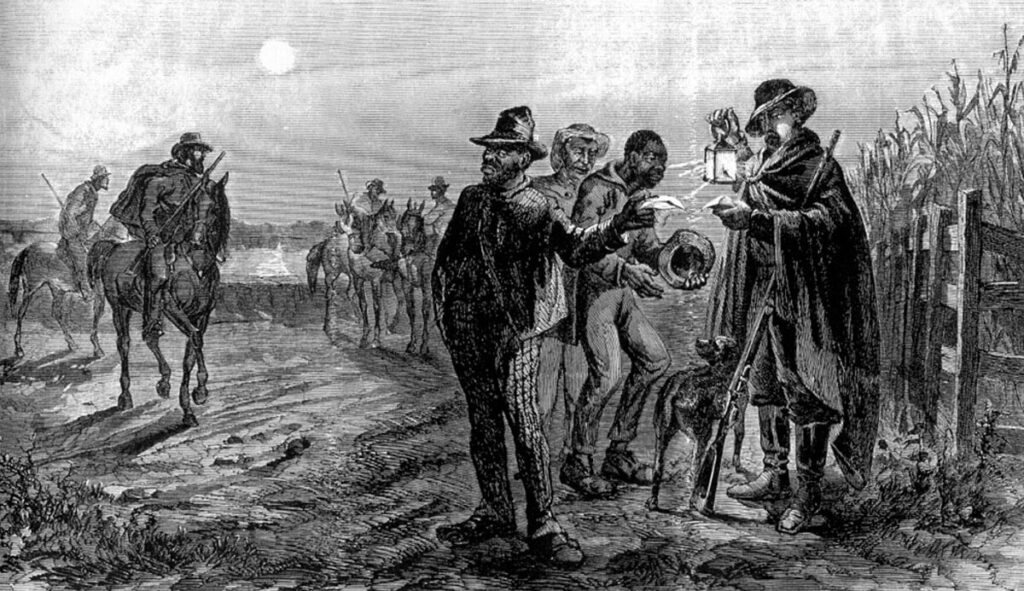
Although the patrols of northern Kentucky occasionally served in the capacity of a civil police force, period legislation and journalism indicate that their principal function was to restrict the movement of the enslaved and apprehend the self-emancipated. Assessing the actions of patrollers, Alex Wing sums up the patrol’s primary functions:
to police the movement of enslaved people outside the plantation environment, checking for passes and catching, punishing, and returning possible runaways; to disperse gatherings of enslaved people, which were routinely deemed suspicious and potentially insurrectionary; and to raid slave quarters, searching for contraband goods ranging from weapons to evidence of education and communication. (275)
State legislation enabled patrollers to “arrest, without warrant, any person found lurking about” and inflict up to ten lashes, but local officials implemented the law haphazardly. Neither the integrity of the patrollers nor the legality of the punishments were closely regulated, as the patrol’s formation and discipline was left to county leadership, who generally were prominent local enslavers (Wickliffe 521). As self-emancipation accelerated around the mid-century, patrols implemented increasingly cruel devices, such as bloodhounds (Tenkotte and Claypool 835). Records show multiple occasions on which mobs formed out of fears that parties of freedom seekers constituted rebellions. Although no rebellions of the enslaved are reliably recorded in any account of Kentucky history, reprisals matched the myth rather than the reality (Klotter and Thompson 162). As Lucas recounts, in 1848 a large party escaped from Fayette and Bourbon counties before being cornered a dozen miles from the river. Despite the party’s plain intention to escape the state, county officials declared the affair a rebellion and executed three leaders (73).
Bibliography
Brucato, Ben. “Policing Race and Racing Police: The Origin of US Police in Slave Patrols.” Social Justice, vol. 47, no. 3/4, July 2020, pp. 115–36.
Coleman, J. W. J. Slavery times in Kentucky. The University of North Carolina press, 1940.
Hadden, S. E. Slave patrols: law and violence in Virginia and the Carolinas. Harvard University Press, 2001.
Klotter, JC, and Friend, C. T. A new history of Kentucky. University Press of Kentucky, 2018.
Lucas, Marion B. A History of Blacks in Kentucky: From Slavery to Segregation, 1760-1891. Kentucky Historical Society, 2003.
Tenkotte, Paul A., and James C. Claypool. The Encyclopedia of Northern Kentucky. University Press of Kentucky, 2009.
Webster, Robert D., and Paul A. Tenkotte. A Brief History of Northern Kentucky. South Limestone, 2019.
Wickliffe, C.A. et al. The Revised Statutes of Kentucky. Frankfort, KY: A.G. Hodges, 1852.
Wing, Alex. “Towards the South as a Carceral Landscape: The Historiography of Slave Patrols in the Antebellum United States.” Reviews in American History, vol. 52, no. 3, Sept. 2024.
Wright, George C. Racial Violence in Kentucky, 1865-1940: Lynchings, Mob Rule, and “Legal Lynchings”. Louisiana State University Press, 1990.
United States Fugitive Slave Law. Hartford, CT, 1850. Retrieved from the Library of Congress.