
The Freedom Seeker and the Canal
As the Ohio legislature deliberated the prospect of constructing a canal network, it found itself in a catch-22: the state’s isolated farmsteads and nubile industries could not get their commerce to more profitable markets due to the remoteness of the region and its sprawling geography; the state’s meager trade revenue meant that it could not afford to develop the transit networks its citizens required. The result was a series of projects, much delayed, often over budget, and frequently unprofitable. Although a network of Ohio canals was signed into law on February 4, 1825, their construction would not be completed for over two decades, and even successful routes, such as the Miami-Erie canal, which connected Cincinnati and Toledo, would be swiftly overtaken by the railroad (Huntington and McClelland 35). Nevertheless, the brief window during which the canal dominated American transit corresponded to an especially urgent period of emancipation. In many corners of the Great Lakes region, the canal forged a path through considerable environmental obstacles that were on the minds of freedom seekers, such as the Great Black Swamp, and everywhere efforts for and against abolition clustered around its expedient pathway.
Conditions of travel
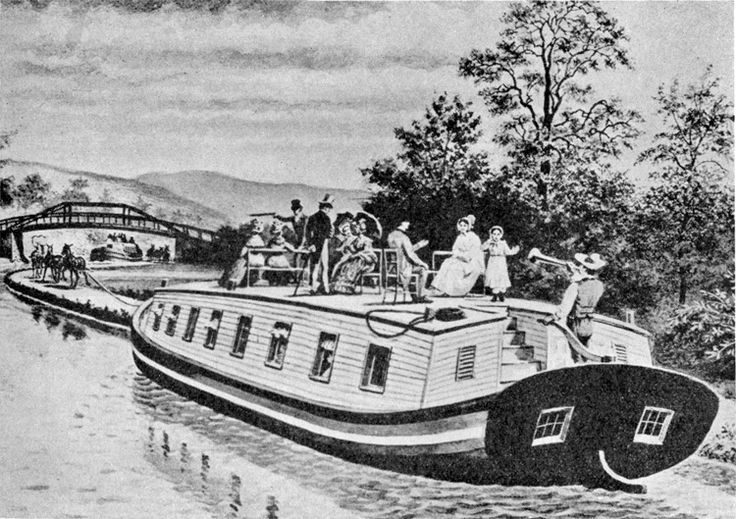
As transit on the Erie and Miami canals opened at last, canal boats provided a welcome alternative to the “swaying stagecoach on rutted or muddy roads,” despite the fact that the water route was generally much slower (Drago 235). Mary F. McCray recalls that for one manumitted family, the canal was a “very poor” means of transportation (21). The arduous speed of the trip would have heightened the risks posed to the family by antagonistic lawyers and hostile enslavers in northern Kentucky. However, despite a thirteen day journey that covered no more than 120 miles from Cincinnati to New Bremen, the family arrived at last in a welcoming neighborhood, which lent its horse teams for the journey’s conclusion. This family’s tedious journey was well worth the cost, especially considering the graciousness of their new neighbors, and the canal’s efficiency only improved in the following years. By the late 40s, steam-powered packets could run between Cincinnati and Toledo in only four days (236).
For Black travelers, even successful passages north involved a host of indignities that proclaimed the canal and its infrastructure to be a white space. Frederick Douglas frequently found himself put out of comfortable accommodations during his travels to and from Rochester. On one occasion he was refused a seat at the breakfast table with other passengers, and on another, he was compelled to sleep on deck (Holland 110). This physical segregation reminded Douglass that the price of travel was not merely discomfort but submission to a massive, racialized infrastructure. Douglass and others would have dwelt on the plain facts that 1) canal travel thrust passengers into untrustworthy company, 2) opportunistic bounty hunters flocked to mass transit, 3) the same bureaucratic mechanisms that set fares in the north calculated the buying and selling of humans in the south. In short, riding the canal could be experienced as an extension of rather than an escape from the institution of slavery.
Working the Canal
Of course, canals did not merely spirit a select few freedom seekers northward to Canada but often became a site that attracted young Black men and women seeking work amidst the disorientation of emancipated life. Pinckney Benton Steward Pinchback, who would later become the first African American governor in the United States, began his canal travels at the age of twelve. After being disinherited by his father’s estate administrator, he took up as a cabin boy on the Canal network of western Ohio (Simmons 760). Especially in the 1830s and 1840s when canal construction boomed, grubbing, clearing, mucking, ditching, embanking, and excavating offered ready employment for unskilled laborers, and the call was taken up especially by emancipated Blacks, as well as by German and Irish immigrants (Schreiber 24). Much of the digging of the Miami extension between Dayton and Defiance was performed by Irish immigrants, while German immigrants cleared the cloying swamplands around the Maumee River (McNutt 116; Drago 230). Free Black laborers preferred to be occupied on canals nearer the Canadian border, where they might flee if and when the need arose. For one and all, working on the canal offered low pay and mean working conditions. Outbreaks of Cholera and Typhoid were common in the diggers’ camps, but the work continued to draw those who were unwelcome or unsafe in the region’s maturing cities (McNutt 116).
While some camaraderie could be expected to extend across race among canal laborers, class tension was more common. Early in life, Reverend Thomas James used the staked route of the incipient Erie Canal to guide his flight during an escape to Canada in 1821 (6). Once safe in Ontario, he returned to the burgeoning canal network for work and helped dig the Deep Cut of the Welland Canal. However, he would soon move on to avoid the “rough lot” employed in this grueling labor (6). Canal workers were indeed a variegated and often “rough” community. According to William Wells Brown, in 1836 the slaveholder Bacon Tate crossed into Canada and kidnapped a family living in St. Catharines, and found a ready posse in American canal workers who had been employed in the region. “Sixty to seventy” barred the road near Buffalo and only after a two-hour running battle, could the party of abolitionist allies return the kidnapped safely to Canada (117). Much as poor white tenant farmers hurried to volunteer for the Kentucky slave patrol, poor white northerners often found themselves inveigled in the machinations of bounty hunters.
Pursuit
Whereas contemporary American transit geography offers innumerable routes by which a traveler might head north, travel remained severely constrained through the 1840s. Even when rail overtook the canal in the 1850s, pricey fares often led freedom seekers to select from a predictably narrow set of options. As a result, period biographies often recount chance encounters between self-emancipated travelers and the agents of enslavers. For instance, in his autobiography, Israel Campbell describes a “very pleasant trip” up the Miami Canal, only to spot a Tennessean merchant in Toledo who had arrested a fugitive in the past (197). What would be a wildly improbable meeting for a contemporary traveler in this case appears to have been determined by a regional bottleneck. Rail, road, and canal all converged upon Toledo, and all alternate routes through Indiana and western Ohio would have forced Campbell onto the crude roadways of southern Michigan, nearly unnavigable in most seasons.
When, in 1851, the self-emancipated Isaac Mason determined to travel from his workplace to attend to his sick wife in Connecticut, he embarked on a journey that made use of every commonplace transit system of the mid-century. After taking a steamer from Toronto to Rochester, then walking a rail line through western New York, he switched again the tow-path of the Erie Canal, before gaining passage aboard a canal boat. Near Utica, NY, Mason was astonished to spot his former enslaver standing on a bridge that crossed the canal, leading him to feel certain he was being hunted (64). Although he was not spotted, Mason quickly made the same calculation as many before him, that going by foot was safer than using the expedient of the canal. The combination of prohibitive fares and limited canal access meant that riders such as Mason must travel by a very few routes, which could be monitored by a small network of bounty hunters. In effect, as Mason sought safe travel, he was forced to envision a map on which canals were marked as veins of danger.
Economics of the Canal
Advocates regarded the Miami-Erie Canal as an economic boon for the large swathes of western Ohio whose agriculture and budding industries could reach no market. When the Erie Canal opened in the northeast of the state, profits on flour more than tripled, from $1.95 a barrel to $6.20 a barrel after transport fees (Drago 221-2). Six months after the first leg of the Miami canal connected Middletown to Cincinnati, a mere 40 miles, 58,000 barrels of flour and 1,800,000 lbs of bacon had moved south by the new route (226). The Great Black Swamp lay at the other end of the proposed route, where the Maumee River let into Lake Erie, but the canal’s completion drove up the population of even this remote corner of the state. As Harry Schreiber puts it, “A large area of sparse settlement in northwest Ohio was given improved transportation for the first time, immigration into the region was given a new impetus, and the commercialization of agriculture was made possible” (220). In fact, the economic incentive implicit to the Ohio canal network helped grow the state’s population by 80% between 1840 and 1850, in large part by granting commercial access to large swathes of arable land (221). In 1851, when the Miami-Erie Canal had provided full service between Cincinnati and the Great Lakes for only five years, more than $400,000 of grain products were passing through Toledo.
While passengers were always a minority cargo on the Miami-Erie, the number of travelers expanded rapidly until the sheer efficiency of the railroad arrived and thrust aside the canal network in the 1850s. Even in 1850, when rail lines had begun competing for the same western Ohio routes as the canal, 20,000 passengers made their way to Toledo by packet boat (Schreiber 237). Subject to the same rigorous fare charts as commercial cargo, these travelers found themselves navigating a changeable landscape of convenience, comfort, and value. Practically speaking, canal riders paid about three cents per mile, which meant that one could pass from Cincinnati to Toledo for about $40 (or $280 at current inflation rates) (235-6). Previous modes of travel, by wagon, carriage, horse, or foot certainly elicited various fees and expenses, but never before had transit been subject to such a massively coordinated economy. Regional idiosyncrasies and local barter systems gave way to timetables, fare charts, and trade contracts. Real-time price adjustments came through by way of the telegraph, and the same network facilitated interstate industrial dealings at speeds that rendered the posted letter obsolete.
This monetization of human passengers had less quantifiable social repercussions as well. That human bodies were implicated in this transit network may seem to the contemporary reader too obvious and ubiquitous to warrant attention, but the significance was not lost on Black riders during the 1840s and ‘50s. The autobiography of Lewis Clarke reminds us of the unposted tolls that must be paid by Black travelers of the canal. While some fortunate could arrange to work for their passage, Clarke was compelled to sell his pony to pay for passage from Cincinnati to Portsmouth, only to spend the journey harangued by a southern sympathizer. As he would put it, “I found the spirit of slaveholding was not all South [sic] of the Ohio River” (36-7). Whether Clarke could make his way across this Midwestern state depended upon his liquid assets and their fungibility within a dense matrix of goods. Even sympathetic pilots could not help but conflate their passengers with the dry goods that often filled the holds of packet boats. The captain who bore Jamie Parker and his companions to safety in Rochester dryly documented his passengers in the manifest as “ten bales of humanity, in a thriving condition, late from three plantations in Virginia!” (Pierson 188).
Bibliography
Berlin, Ira. Generations of Captivity: A History of African-American Slaves. Harvard UP, 2003.
Cullen, Sarah. “‘Let Him Be Left to Feel His Way in the Dark;’ Frederick Douglass: White Surveillance and Dark Sousveillance.” Flynn and Mackay (2018): 191-206.
Gault, Erika. “‘My People Are Free!’: Theorizing the Digital Black Church,” Fire!!! 6 (2020): 1–16.
Lussana, Sergio A. “Enslaved Men, the Grapevine Telegraph, and the Underground Railroad.” My Brother Slaves: Friendship, Masculinity, and Resistance in the Antebellum South. Ed. Sergio A. Lussana. UP of Kentucky, 2016. 125–46.
Robinson, William H. From Log Cabin to the Pulpit: Or Fifteen Years in Slavery. Eau Claire, WI: The Author, 1913.
Rudd, Daniel A., and Theophilus Bond. From Slavery to Wealth: The Life of Scott Bond, the Rewards of Honesty, Industry, Economy and Perserverance. Madison, Ark.: The Authors, 1917.
Smith, Harry. Fifty Years of Slavery in the United States of America. Grand Rapids, MI: West Michigan, 1891.
Thompson, Charles, Biography of a Slave; Being the Experiences of Rev. Charles Thompson, a Preacher of the United Brethren Church, While a Slave in the South. Together with Startling Occurrences Incidental to Slave Life. Dayton, Ohio: United Brethren Publishing House, 1875.