
The Great Black Swamp
Larger than the state of Connecticut, the Great Black Swamp once stretched from the western shores of Lake Erie to Fort Wayne. The Maumee River formed the swamp’s northern border, and a lowlying region of tributary creeks extended nearly fifty miles to the south. While the topography, flora, and fauna varied, early travelers remarked especially on the dense groves that rose out of “black, oozing muck” (McNutt 111). Saturated clay and lime lay at least a foot thick in all seasons, but reports abound of livestock and wagons disappearing entirely into the mud. A few inches of standing water covered much of the swamp, and its watershed graded toward the lake at less than five feet per mile. In winter months, lake-effect storms could freeze belabored travelers or animals in place, as one Christian Lauber discovered. After freeing his oxen from a frozen creek, Lauber found it easier to slide his gear across the ice than bear it through the viscous mud (113). Fauna too made the Swamp a forbidding region. Many travelers fought wolves to win passage, but disease-bearing mosquitos were by far the greater threat. Yet, despite all of its hazards, during the mid-nineteenth century an influx of the intrepid and the desperate still sought out the Great Black Swamp.
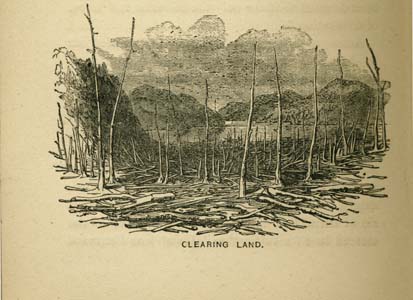
Indigenous Odawa dwelt in the lands around the Great Black Swamp when French settlers first entered the region during the late-eighteenth century; however, local tribes used the inhospitable forests only for trapping and hunting (Kaatz 7). Until the war of 1812, travelers might hope to strike an unflooded trail, but even the boldest surveyors would prefer to pass between (modern) Michigan and Ohio by traveling by the Great Lake or far to the west. Built in 1827, the West Reserve Road joined Freemont and Perrysburg, Ohio across the swamp, but it remained an unreliable track, open only during the summer months, and even so conveying travelers as little as one mile per day. Some would describe it as the worst road on the continent (11). Following the surrender of fort Detroit during the war of 1812, soldiers under General Hull were among the first white travelers of the swamp, and they would quickly dub it “their personal hell” (McNutt 112).
Yet, the northward progress of the Miami-Erie canal soon brought new residents to the region. Initially Irish and German ditch-diggers set up shanty towns along the Maumee river. In the summer months vast clouds of mosquitos halted work and devastated the camps with Malaria, Cholera, and Typhoid. Astonishingly, by the time the canal was completed in 1843, many of the peripatetic workers had converted to residents. Randy McNutt describes the socio-economic motivations that drove these early settlers: “the land was cheap. Nobody wanted it. Europeans accepted the swampy conditions better than most Americans, perhaps because they were used to wet land at home. Where most people saw death and misery, the immigrants saw opportunity” (119). In some sense, the grit of the immigrant settlers paid off as trade soared along the Miami-Erie. Land values rose, and new waves of settlers hashed the swamp’s arable fringes into homesteads.
Bibliography
Adamich, T. (2021). Local History: Hull’s Trace Was One of Early Interstate Highways. The Monroe News, Oct. 18, 2021.
Hoeken, William T. The Black Swamp and Its Effect on the Development of Northwestern Ohio. Van Wert, Ohio: Van Wert Public Library, 1962.
Kaatz, M. (1955). The Black Swamp: A Study in Historical Geography. Annals of the Association of American Geographers, Vol. XLV, No. 1, 1-35.
Kinney, Ken. “Black Swamp Once Ruled the Land and People.” Bowling Green Sentinel Tribune, June 10, 1999.
Lopez, P. (1982). The Story of the Great Black Swamp. WBGU Documentaries. Retrieved on Jan. 8, 2022 from: https://www.pbs.org/video/wbgu-documentaries-the-story-of-the-great-black-swamp/
McNutt, Randy. Lost Ohio: More Travels into Haunted Landscapes, Ghost Towns, and Forgotten Lives. Kent State University Press, 2006.
Mitsch, W.J. and J.G. Gosselink. Wetlands. John Wiley and Sons, 2015.