
Marronage in American Swampland
Whereas enclaves of the self-emancipated had formed in central Indiana, western Ohio, and southern Michigan, few accounts mention Black residents of the Great Black Swamp region. In part, the nearby “city of refuge,” Canada, shapes this historical gap. Many freedom seekers would ask, why not complete the full measure and cross the border, which was but a few hours’ trip from Toledo by boat? However, the dearth of records also suggests that those who sought out the swamp favored its privacy; it forcefully resisted the Midwest’s socialization, and so it lacked many of the expedients that abetted bounty hunters elsewhere in the region. Despite the lack of records, the prominent example of the maroon communities in the Great Dismal Swamp of Virginia and North Carolina clarifies the way Black travelers and residents may have interpreted the Ohio wetlands.
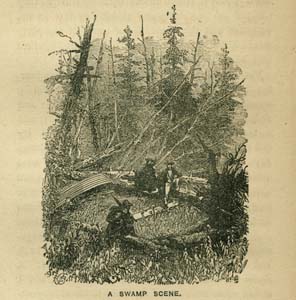
Like the Great Black Swamp, the perpetually flooded lowlands of the Dismal were nearly impassable in all seasons, and although ice was no threat, poisonous snakes haunted its waters. So-called “maroons” came to reside in the Dismal Swamp through a complex of motivations. According to J. Brent Morris, maroons often distinguish themselves from other self-emancipated by extreme peril–as for those accused of serious crimes–as well as extreme stubborness–as for those unwilling to cede their regional home to slaveholders. Yet, a mindset that would apply equally to a southern and northern maroon is what James Spady has called “psychic marronage,” that is, elected isolation from white supremacist society, as a way of reconstituting dissent (31). By establishing their livelihood within but in some sense against the infrastructure of American society, the maroon refused to fly in humiliation or to acquiesce to domination. This defiant posture may have aligned the attitudes of Black residents of the Great Black Swamp with the grit demonstrated by the region’s immigrant communities; although Black settlers knew peril far beyond that of the displaced and impoverished German or Irish immigrant, both groups sustained communities where privileged settlers balked.
The Ohio wetland would have reinforced the ecological perspectives of many Black communities as well. In the case of the Dismal Swamp, Tynes Cowen argues that “the composition of a swamp, trees and water (a combination of forest and lake), could echo the significance of those two elements in African religion” (62). Similar associations would apply to the northern region. This is not to say that a mosquito-ridden morass appealed to Black settlers in some numinous sense; rather, a spiritual heritage sustained by way of oral tradition may have revealed a form of hospitality woven in and through the wetland’s rigors. Work in wetlands, such as “mucking” canals, could be inflicted upon white immigrants as a cultural indignity: ebbing waters interrupted the mechanics of modern trade; sinuous watercourses disrupted the thoroughly rationalized grid of the European city; technological novelties of industry literally sunk into the mud (Mcnutt 117). By contrast, the celebration of flora and water characteristic of many west-African cultures had been sustained as slaveholders housed their captives on the fringes of arable land throughout the south. Those self-emancipated who passed north on the Miami-Erie canal might have recognized the swamp’s borders as an example of this troubled model of home that they had inherited.
By the 1850s, residents and speculators had come to believe that the spirit of industry could overcome even the Great Black Swamp. As Randy McNutt puts it,
Pioneers saw the forests as a challenge to their collective ax. They chopped, sawed, smashed, bumped, banged, and pulled down as many trees as possible. Or they held “burning bees,” competitions to burn down the forests. The earliest settlers found 95 percent of Ohio filled with trees—twenty-five million acres of virgin forest. (Today, naturalists identify only about seven hundred Ohio forested acres as virgin.) (117)
In 1859, the demand for farmland, a burgeoning timber industry, and the expedient of the railroad compelled the Ohio legislature to drain the swamp. Despite the region’s very slight gradient toward Lake Erie, ditches and rudimentary tiles dried much of the swampland within a few years (Laatz 23). What had been virtually impassable fifty years earlier, came to resemble much of the midwestern plain: a patchwork of farmsteads with a proliferating network of roads and railways. These rapid changes, which ran up to and through the American Civil War, made the freedom seeker’s northward trajectory uncertain but ultimately more open-ended. As transit expanded, travelers could circumscribe regional bottlenecks such as Toledo, where bounty hunters waited. Yet, at the same time, the draining of the swamp subjected the region to the apparatus of industry: its tolls, timetables, and bureaucracies. The wetlands, which for the freedom seeker had conjoined hardship to hospitality, had disappeared.
Bibliography
Adamich, T. (2021). Local History: Hull’s Trace Was One of Early Interstate Highways. The Monroe News, Oct. 18, 2021.
Cowan, William Tynes. The Slave in the: Disrupting the Plantation Narrative. Routledge, 2005.
Hoeken, William T. The Black Swamp and Its Effect on the Development of Northwestern Ohio. Van Wert, Ohio: Van Wert Public Library, 1962.
Kaatz, M. (1955). The Black Swamp: A Study in Historical Geography. Annals of the Association of American Geographers, Vol. XLV, No. 1, 1-35.
Kinney, Ken. “Black Swamp Once Ruled the Land and People.” Bowling Green Sentinel Tribune, June 10, 1999.
Lopez, P. (1982). The Story of the Great Black Swamp. WBGU Documentaries. Retrieved on Jan. 8, 2022 from: https://www.pbs.org/video/wbgu-documentaries-the-story-of-the-great-black-swamp/
McNutt, Randy. Lost Ohio: More Travels into Haunted Landscapes, Ghost Towns, and Forgotten Lives. Kent State University Press, 2006.
Mitsch, W.J. and J.G. Gosselink. Wetlands. John Wiley and Sons, 2015.
Mollenkopf, Jim. The Great Black Swamp: Historical Tales of 19th-Century Northwest Ohio. Toledo, Ohio: Lake of the Cat, 1999
Morris, J. Brent. Dismal Freedom: A History of the Maroons of the Great Dismal Swamp. The University of North Carolina Press, 2022.
Marcus P. Nevius. City of Refuge: Slavery and Petit Marronage in the Great Dismal Swamp, 1763–1856. University of Georgia Press, 2020.
Plumber, Elizabeth L. “Glacier Left Black Swamp.” Bowling Green Sentinel Tribune, September 8, 1977.
Sayers, Daniel. A Desolate Place for a Defiant People: The Archaeology of Maroons, Indigenous Americans, and Enslaved Laborers in the Great Dismal Swamp, University Press of Florida, 2014.
James Spady, “Belonging and Alienation: Gullah Jack and Some Maroon Dimensions of the ‘Denmark Vesey Conspiracy,’” in Bodek and Kelly, Maroons and the Marooned, 31–32, 48–49.
Wilhelm, Peter. “Draining the Great Black Swamp: Henry and Wood Counties, Ohio; A Case Study in Agricultural Development.” M.A. thesis, Bowling Green State University, August 1983.