
The Freedom Seeker and the Railroad
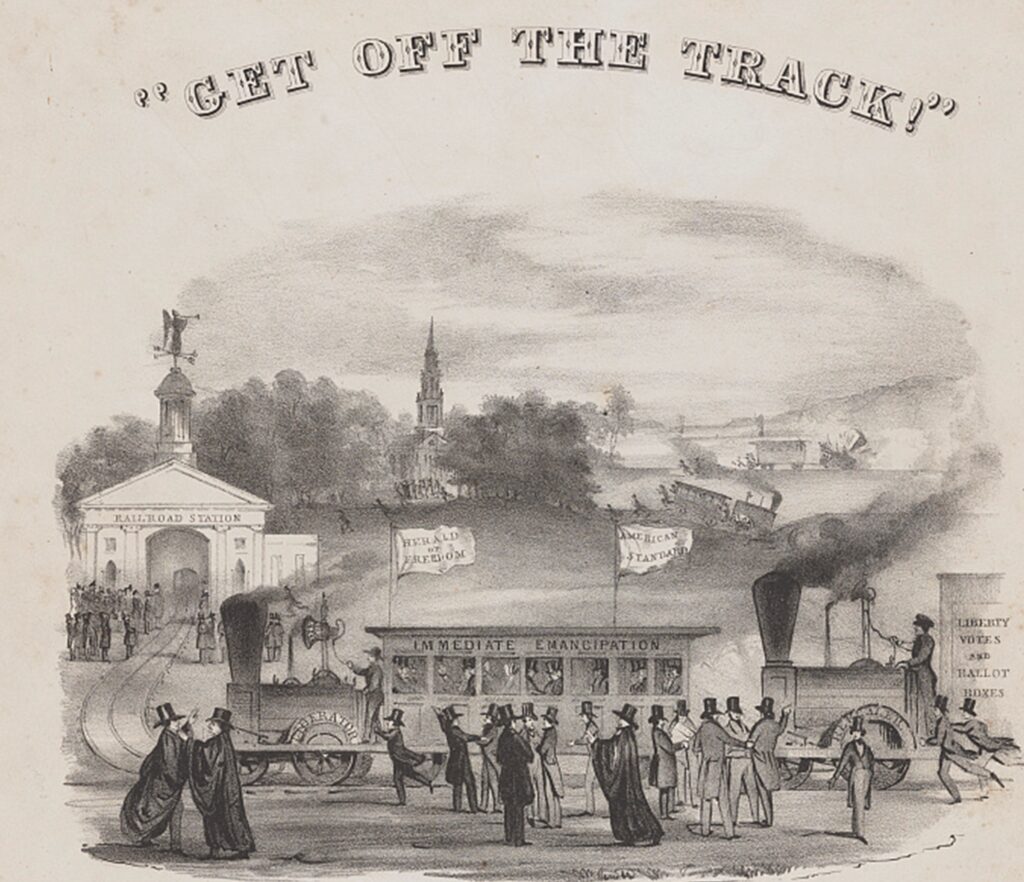
During the 1830s and 1840s, steam locomotives transformed from an astonishing new contraption into an integral part of American transportation. Many of the popular depictions of early rail that circulate today depict the railroad as a consummate symbol of manifest destiny. Observing the vast scope and power of the rail, many wondered what American ingenuity could not overcome. The country almost seemed to have changed shape and size since steamboats and railroads had, in the words of Sojourner Truth, “annihilated distance” (49). However, the rapid expansion and complexification of American rail networks during these years came as political tensions escalated between northern and southern states around the issue of slavery. While popular enthusiasm for the locomotive was alive among Black Americans too, the technology also was understood as an instrument of the enslaver and yet another manifestation of white domination.
Rail Peril
By the mid-nineteenth century, the American landscape was overlaid with a dense web of rail lines, and a self-emancipated person inevitably encountered one on any northward route. For many, escaping by rail meant walking along rail lines through the rugged contours of the American landscape. While main roads came with the significant risk of discovery and pursuit, rail often took relatively direct northward routes through lightly inhabited countryside and could be traversed by night. Nevertheless, many such escapes were like that of Isaac D. Williams, who encountered a suspicious local and only escaped by dodging gunfire (26-31).
For most freedom seekers, traveling onboard trains was too dangerous to be considered. As William G. Hawkins puts it in Lunsford Lane, “every colored man, if a stranger, passing through [North Carolina], whether by railroad or upon the highways, is considered a slave escaping from his master” (105). The risks of traveling by train led many to enact elaborate deceptions and endure incredible hardships. In March of 1849, Henry Box Brown famously shipped himself in a box, 3 by 2.5 by 2 feet in dimension. He spent 27 hours in the compartment, being jostled from train, to boat, to wagon, and was at one point loaded upside down, before eventually attaining freedom in Philadelphia.
Even those who encountered the railroad in northern states could not shake a sense of danger. On one of Harriet Tubman’s rescues, one “Joe” of her party feared the railroad even in New York State, feeling that “surely suspicion would fall upon them, and they would be seized and carried back” (47). In her autobiography, Harriet Jacobs describes a pause in her northward journey in Philadelphia, where she “had a dread of meeting slaveholders, and some dread also of railroads” (246). Her parallelism suggest that the risk of riding rail was of the same type if not the same magnitude as that of encountering an enslaver. Oftentimes these very reasonable fears about the risks of discovery coincided with the novelty of the technology. For instance, in his autobiography, Charles Thompson describes one companion beginning to run at the “shrill shriek” of the train whistle (74). The whistle was, of course, not a direct threat to his freedom, but Thompson’s instincts were attuned to the hard truth that any train might be carrying slave catchers northward.
Ticket to Ride
On top of the risk of encountering enslavers on the trains, freedom seekers and free Black travelers faced cruel discrimination, unequal fares, constant surveillance, and capricious regulations. As Charles Waddell Chesnutt explains in Frederick Douglass, “on railroads and steamboats [Black travelers] were herded off by themselves in mean and uncomfortable cars” (36). In his biography of the same, Booker T. Washington captures the difficulties of rail travel beyond the mere risk of apprehension:
Every one applying for a railway ticket was required to show his “free papers” and to be measured and carefully examined before he could enter the cars. Besides this, he was not allowed to travel by night. Similar regulations were enforced by steamboat companies In addition to all these difficulties, every road and turnpike was picketed with kidnappers on the lookout for fugitive slaves. Douglass found it much easier to learn the obstacles than the aids to successful escape. The former were many and obvious; the latter were few and difficult to discover. It was impossible to profit by the experience of those who had run the gauntlet successfully, and whenever it was learned that some keen-scented slave had found a pathway to freedom, the information was carefully concealed from those in bonds. Every slave preparing to escape his fetters must act without guide or precedent, and form his own plan of deliverance. (54-5)
Here we see that information was among the chief resources withheld from the enslaved, and the arcane, changeable rules of rail travel often only could be learned through error. White ownership of the rail meant that the entire system of regulation and control might be exerted against Black riders, and only the experienced could hope to dispute unjust traveling conditions. Still, many dared such disputes. On multiple occasions Frederick Douglass refused to leave the segregated white car and was beaten. Nevertheless, such intrepid forms of opposition established a foundation for later years, when Washington and others led campaigns for equitable traveling conditions (Scott 102).
Railroad Innovators
Despite the railroad’s instrumental role in the mechanisms of control, pursuit, and capture in the antebellum years, it was a technology that many African Americans helped develop with mind and body. American folklore, such as the tale of John Henry, often records the importance of rail labor (especially spike-driving) to emancipated peoples, but such popularized depictions rarely capture the adversity faced by Black workers who contributed to American rail. In his autobiography, Sterling N. Brown recalls begging for work shoveling gravel along one line and completed a full day’s labor with great difficulty but was dismissed as unfit for the work (10).
The intellectual labor of African Americans also suffused the railroad, such as Granville T. Woods’s countless inventions, which included an ingenious “electrical railway telegraph” that could transmit communications mid-transit (Simmons 108). Such accomplishments helped form Booker T. Washington’s imagination of Black uplift, in which he believed the railroad should play a crucial part. One of his rail-building associates, for example, educated Black farmers in agricultural techniques as the railway passed near their land (Scott 257). Although African Americans had played indispensable roles in the design, construction, and maintenance of the American rail network, they largely remained divested of ownership. M.L. Latta lamented this disparity that by no means declined following emancipation, saying, “the Anglo-Saxon race owns everything in the Southern States. They own the land, they own the money, they own the railroads” (17). The same was true in the north, and ownership has hardly shifted in the century and a half since.
Bibliography
Bradford, Sarah Hopkins. Harriet, the Moses of Her People. New York: George R. Lockwood, 1886.
Brown, Henry Box. Narrative of Henry Box Brown, Who Escaped from Slavery Enclosed in a Box 3 Feet Long and 2 Wide. Written from a Statement of Facts Made by Himself. With Remarks Upon the Remedy for Slavery. Boston: Brown and Stearns. 1849.
Brown, Sterling Nelson, 1858-1929. My Own Life Story. Washington, DC: Hamilton, 1924.
Drew, Benjamin, ed. A North-Side View of Slavery. The Refugee: or, The Narratives of Fugitive Slaves in Canada. Related by Themselves. With an Account of the History and Condition of the Colored Population of Upper Canada. Boston: J. P. Jewett, 1856.
Hawkins, William G. Lunsford Lane; or, Another Helper from North Carolina. Boston: Crosby and Nichols, 1863.
Jacobs, Harriet Ann. Incidents in the Life of a Slave Girl. Written by Herself. Ed. Lydia Maria Child. Boston: The Author, 1861.
Latta, Morgan London. The History of My Life and Work: Autobiography by Rev. M. L. Latta, A.M., D.D. Raleigh: The Author, 1903.
Mason, Isaac, Life of Isaac Mason As a Slave. Worcester, MA: The Author, 1893.
Scott, Emmett Jay, and Lyman Beecher Stowe. Booker T. Washington, Builder of a Civilization. Garden City, New York: Doubleday Page, 1916.
Simmons, William J. Men of Mark: Eminent, Progressive and Rising. Cleveland: Rewell, 1887.
Thompson, Charles. Biography of a Slave; Being the Experiences of Rev. Charles Thompson, a Preacher of the United Brethren Church, While a Slave in the South. Dayton, OH: United Brethren, 1875.
Truth, Sojourner. Narrative of Sojourner Truth, a Northern Slave, Emancipated from Bodily Servitude by the State of New York, in 1828. Ed. Olive Gilbert. Boston: The Author, 1850.
Williams, Isaac D., 1821-1898. Sunshine and Shadow of Slave Life: Reminiscences As Told by Isaac D. Williams to “Tege.” Ed. William Ferguson Goldie. East Saginaw, MI: Evening News, 1885.
Washington, Booker T. Frederick Douglass. London: Hodder and Stoughton, 1906.