
The Licking River
The earliest European settlers and surveyors of Kentucky made use of the Licking River “via flatboats, keelboats, rafts, and eventually steamboats” (Tenkotte and Claypool 13). As settlers joined in the furious land-grab in the region, this route only grew in popularity, especially given the region’s dismal roadways. Before the Covington and Lexington Railroad joined Kentucky’s two most populous cities in 1851, the Licking River offered the most efficient means of transporting goods and passengers from its central to northern regions. However, while the state initiated a network of 21 locks and dams in 1830 that would permit “slack-water” travel, the project languished and ultimately was abandoned by mid-century (548). As across the country, in Kentucky rail had outrun river infrastructure. Soon stone shorings and dam foundations had begun to be reappropriated for more efficient projects, such as the John A. Roebling Bridge that would connect Covington and Cincinnati by the end of the war.
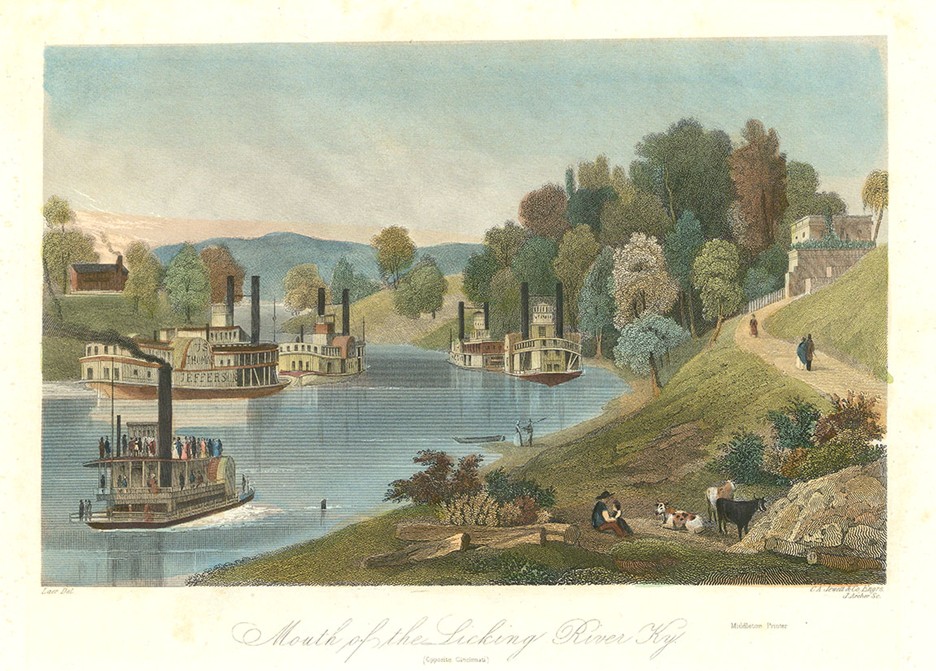
In 1803, the Newport Barracks was built to the east of the Licking River’s mouth where a steam-driven sawmill had fostered a strong lumber industry, and by 1850, river trade had swelled the community to nearly 6000 (Webster 121-2). Immediately south of Cincinnati lay the populace Boone county. Mills and iron works drew on the waters of Licking and lined its banks as the shores of Ohio came into sight (137). Covington’s emerging iron and meatpacking industries drew settlers and businesspeople whose homesteads and businesses would have overlooked the mouth of Licking and any who travelled its waters. (Tenkotte and Claypool 548).
Where the Licking met the Ohio River, the cities of Covington and Newport formed the northernmost vestige of slavery in the American Midwest. While these waterways and the high populations of the enslaved in Boone (Covington) and Mason (Maysville) counties drew special attention from county patrols, the proximity of the Cincinnati Underground Railroad also made the region a site of frequent liberations. The industrial bustle of the Licking’s mouth prompted various buildings and homesteads to construct tunnels that led to the water’s edge, and as the energy for emancipation whelmed in the 1850s, these passages assisted the work of abolitionists such as Henry Hathaway Jr. and Jacob Price (Webster 149).
Bibliography
Klotter, JC, and Friend, C. T. A new history of Kentucky. University Press of Kentucky, 2018.
Tenkotte, Paul A., and James C. Claypool. The Encyclopedia of Northern Kentucky. University Press of Kentucky, 2009.
Webster, Robert D., and Paul A. Tenkotte. A Brief History of Northern Kentucky. South Limestone, 2019.