
The Freedom Seeker and the Telegraph Network
Although many remember Samuel Morse for his work as an inventor of the telegraph, few recall his ardent support for the institution of slavery. Yet, from its very conception this electronic communication technology was closely linked to the observation and control of enslaved peoples. During the years leading up to the Fugitive Slave Act of 1850, the telegraph network expanded rapidly across the United States, especially along the east coast and in the Great Lakes region. On April 6, 1848, Chicago’s western line joined Detroit’s eastern line. This merged the two largest segments of telegraph service in the country, but it also completed a barrier that cut across all underground railroad routes east of the Mississippi River. For many Americans, it quickly became a part of everyday life, and many records report its role in abolitionist communications. However, in the stories recounted in this project, the telegraph primarily served as an early form of technological surveillance that enabled slave catchers and imperiled self-emancipated people in unprecedented ways.
Telegraphic Surveillance and the Slave Catcher
In many first-hand accounts, when potential self-emancipators measured their mobility and self-determination against that of the slave patrol, the telegraph tipped the scales, nipping in the bud any hope of escape. In Benjamin Drew’s collection of freedom-seeker narratives, A North-Side View of Slavery (1856), William Grose describes his northward flight in 1851 as burdened by the threat of the telegraph line:
All the way along, I felt a dread—a heavy load on me all the way. I would look up at the Telegraph wire, and dread that the news was going on ahead of me. At one time I was on a canal-boat—it did not seem to go fast enough for me, and I felt very much cast down about it; at last I came to a place where the Telegraph wire was broken, and I felt as if the heavy load was rolled off me. (56)
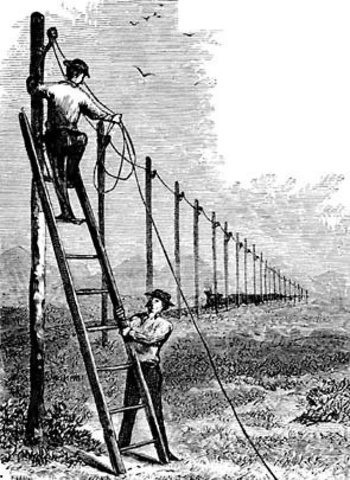
Even the relative expediency of the canal-boat cannot compete with the threat of the telegraph that could, as it seemed, summon slave patrols at any moment and to any point shy of the Canadian border. Although slave patrollers would congregate and await intelligence at the telegraph office, and the presence of a wire offered no special threat to the freedom seeker, the communication network symbolized the malice of its operators to all who encountered it. At times traveling alongside the wire for miles, Grose would have known a perpetual reminder of the sheer geographic scope of slavery’s surveillant network. Despite the actual wire’s deafness, its psychological burden was heavy.
Although the wire itself offered no literal threat of surveillance, the telegraph network still served as an organizing geometry for various authorities, who ranged from the vigilante, to the ad hoc militiaman, to the proto-police force, to the military. For example, in August of 1849, local citizens stated in the Eastern Star paper of Talbot Country, Maryland, that they thought it “advisable for the Slave Holders of the Eastern Shore to establish a line of Telegraph down the peninsula, and organize an efficient police force along the line, as the most effectual means of protecting their slave property, and recovering such as may attempt to make their escape” (Eastern Star in Larson, 86). The proposed police force would conform its enforcement scheme to the route of the telegraph and thereby employ itself more efficiently in response to news of further escape attempts.
Freedom in the Wire
While the telegraph primarily empowered enslavers and slave catchers, its infrastructure often was contested by freedom-seekers, abolitionists, and allies. Following John Brown’s raid on Harper’s Ferry, Frederick Douglass only narrowly escaped capture through the bold aid of an operator who undercut the telegraph’s typically instrumental transmission of federal communication. In his first-hand account, operator John Hurn writes, “when I received the dispatch I was frightened nearly out of my wits. As I was an ardent admirer of the great ex-slave, I resolved to warn Douglass of his impending fate, no matter what the result might be to me” (46). We should pause and speculate on the operator’s reasoning in this case. First, we might imagine what would have transpired had the suspect been less noteworthy or well-respected. Conceivably, the threat of repercussions might have dissuaded Hurn, or an operator of less moral integrity might have refused help. Second, Hurn’s pessimism encourages us to presume that the telegraph system had aligned its power with pro-slavery outcomes, especially in the case of the John Brown Raid, which had been publicized as an attack on the federal government rather than a concerted strike against the institution of slavery. Further, we should recognize that Hurn feared that his discrete private communication would be discovered. While we can only guess at what specific forms of oversight characterized Philadelphia’s telegraphic office, it seems clear that an overwhelming presumption of surveillance characterized not just the subjects of the telegraphic network, but its operators as well.
Future Telegraphs
By the Civil War years, the telegraph was widely used for all urgent civic communication, and the Emancipation Proclamation was no exception. According to Frederick Douglass, a relay of individuals connected the telegraph office to a gathering at the racially integrated Tremont Temple in Boston. From the stage, one Judge Thomas Russell exclaimed that “it is coming, it is on the wires.” (Life and Times, 428). Russell’s exuberant phrasing suggests that not just the speech, but the freedom it described moved through the conduit of the telegraph wire. It seems that, despite weighty associations with surveillance, fugitivity, and pursuit, the technology could be reclaimed for abolition. However, the legal end of slavery would not be the end of the telegraph’s role in shaping the lives of Black Americans. Wired communication would continue to spread messages of freedom, as well as the fruits of Black culture, but neither had the legacy of racialized surveillance come to an end with the Proclamation. In many ways, electronic communication and data technology are as concerned today with the observation and control of Black Americans as they were in 1850.
Despite the serious threat posed by the telegraph, Black Americans entangled their lives with communication technology in intricate ways that bar simplistic oppositions. In Reminiscences of School Life (1913), for example, Fanny Jackson Coppin declares her amazement at transatlantic telegraphy and asserts that “it will not be many years before we shall be able to talk with the people on Mars, and if there are none in the moon we shall be able to know it!” (101). In Coppin’s statement, the technology opens a door, as it were, in the seeming iron-clad paradigms that had constrained Black social mobility. In her words, the (wireless) telegraph works against the human tendency to allow “thoughts and aspirations to be limited by [the earth’s] twenty-five thousand miles of circumference” (101). If the network can transcend the ocean, the logic goes, then human innovation can transcend even the legacy of slavery. While at a superficial level this reveals the extreme optimism that some Black interpreters invested in the telegraph, it also measures the repercussions that the technology had in existential dimensions of African American life. Technology, it was understood, held power to transcend the normal physical dimensions of human livelihood, either enabling unprecedented mobility or asserting astonishing constraints.
Bibliography
Browne, Simone. Dark Matters: One the Surveillance of Blackness. Durham: Duke UP, 2015.
Craft, William. Running a Thousand Miles for Freedom; or, The Escape of William and Ellen Craft from Slavery. London: William Tweedie, 1860.
Cullen, Sarah. “Let Him Be Left to Feel His Way in the Dark;” Frederick Douglass: White Surveillance and Dark Sousveillance.” Flynn and Mackay (2018) 191–06.
Douglass, Frederick. Life and Times of Frederick Douglass Written by Himself. His Early Life as a Slave, His Escape from Bondage, and His Complete History to the Present Time. Hartford, CT: Park, 1881.
Drew, Benjamin, ed. A North-Side View of Slavery. The Refugee: or, The Narratives of Fugitive Slaves in Canada. Related by Themselves. With an Account of the History and Condition of the Colored Population of Upper Canada. Boston: J. P. Jewett, 1856.
Gilmore, Paul. “The Telegraph in Black and White.” ELH 69.3 (2002): 805–33.
Jackson-Coppin, Fanny. Reminiscences of School Life; and Hints on Teaching. Philadelphia: A. M. E. Book Concern, 1913.
Larsen, Kate Clifford. Bound for the Promised Land: Harriet Tubman: Portrait of an American Hero. New York: One World, 2004.
Loguen, J. W. The Rev. J. W. Loguen, as a Slave and as a Freeman. A Narrative of Real Life. Syracuse: J. G. K. Truair & Co., 1859.
Lussana, Sergio A. “Enslaved Men, the Grapevine Telegraph, and the Underground Railroad.” My Brother Slaves: Friendship, Masculinity, and Resistance in the Antebellum South. Ed. Sergio A. Lussana. Lexington: UP of Kentucky, 2016. 125–46.
Marnie, Richard. “Fusing Race: The Phobogenics of Racializing Surveillance.” Surveillance & Society 18.1 (2020): 12–29.
Monahan, Torin. Crisis Vision: Race and the Cultural Production of Surveillance. Durham: Duke UP, 2022.
Nathaniel, Steven. “Telegraphic Surveillance, Psychic Dislocation, and the Data of Black Biography,” Arizona Quarterly 80.1 (2024): 29-56.
Womack, Autumn. “Visuality, Surveillance, and the Afterlife of Slavery.” American Literary History 29.1 (2017): 191–204.